

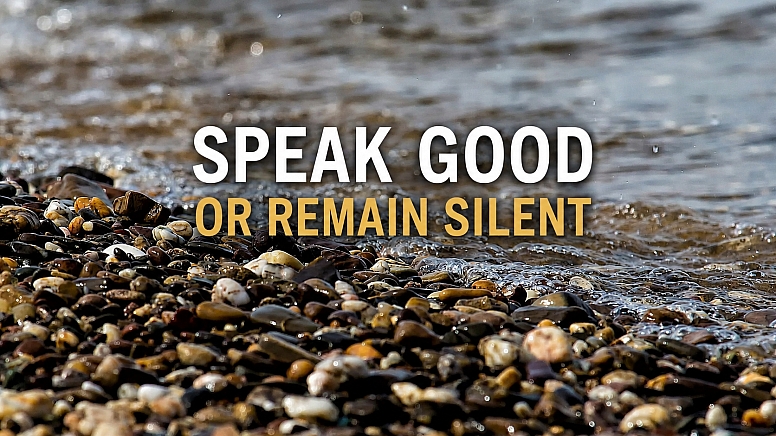
Speak Good or Remain Silent
The Messenger of Allah ﷺ said:
“Whoever believes in Allah and the Last Day, let him speak good or remain silent.”
Sahih al Bukhari, 6018; Sahih Muslim, 47
Few teachings are as brief, yet as far reaching, as this one. It places our speech within the framework of faith and reminds us that what we say is not separate from how we live as Muslims.
The hadith does not ask us to become silent people. It asks us to become responsible people.
The Value of a Word
A good word can be an act of kindness, a means of reconciliation, a source of encouragement, or a reminder that brings someone closer to Allah. Sometimes it is a word of gratitude. Sometimes it is an apology. Sometimes it is simply telling someone, “I understand.”
The Prophet ﷺ also said:
“A good word is charity.”
Sahih al Bukhari, 2989; Sahih Muslim, 1009
This gives ordinary conversation a deeper meaning. A person does not need wealth, influence, or a grand opportunity to do good. A sincere word, spoken at the right moment, can itself be an act of charity.
Silence Is Not Weakness
There are moments when speaking is necessary. Truth may need to be defended, injustice may need to be addressed, and someone may need advice or comfort. Silence is not always the better choice.
But there are also moments when speaking adds nothing except harm.
A harsh reply may satisfy us for a few seconds and leave someone hurt for much longer. A careless comment may become a source of embarrassment. A rumour may travel further than the truth ever did. In such moments, remaining silent is not a failure to express ourselves. It is an exercise of self control.
The Qur'an reminds us that Allah knows what we say:
“He does not utter any word except that with him is an observer prepared.”
Surah Qaf, 50:18
This is not a reason to become fearful of every conversation. It is a reason to become mindful of the weight our words carry.
Before You Speak
The hadith offers a simple question to carry into daily life:
Is what I am about to say good?
If the answer is yes, speak with sincerity. If it is not, ask whether silence would be better.
This can change the way we approach disagreements, family conversations, friendships, and even the things we share online. We may begin to pause before replying, choose a gentler expression, or decide that a private conversation is better than a public remark.
The aim is not to measure every sentence with anxiety. It is to develop a habit of thoughtfulness.
A Sunnah We Can Practise Every Day
The beauty of this teaching is that it belongs to ordinary life.
It is choosing encouragement over unnecessary criticism. It is refusing to pass on something we have not verified. It is speaking honestly without being cruel. It is knowing when advice is helpful and when someone simply needs to be heard.
It is also recognising that silence can be a form of worship when it protects us from saying what displeases Allah.
The Prophet ﷺ said:
“The Muslim is the one from whose tongue and hand the Muslims are safe.”
Sahih al Bukhari, 10; Sahih Muslim, 40
Our speech should therefore be a source of safety, not a source of fear. People should feel that our words can be trusted, that our advice is sincere, and that our presence does not require them to defend themselves.
A Better Way to Live
Speaking good is not about having something impressive to say. It is about having something worthwhile to contribute.
A person who speaks less, but speaks with wisdom, may leave a greater impression than someone who is always eager to be heard. A person who knows when to remain silent may preserve a friendship, protect a person's dignity, or save themselves from a word they would later regret.
The next time we feel the urge to respond, we can pause and ask:
Will this bring goodness, or would silence be better?
That small pause can become a habit. And a habit of thoughtful speech can become part of a person's character.
May Allah make our words truthful, beneficial, and kind, and grant us the wisdom to remain silent when silence is better.
LEAVE A COMMENT
Categories
Recent Posts









0.0213