

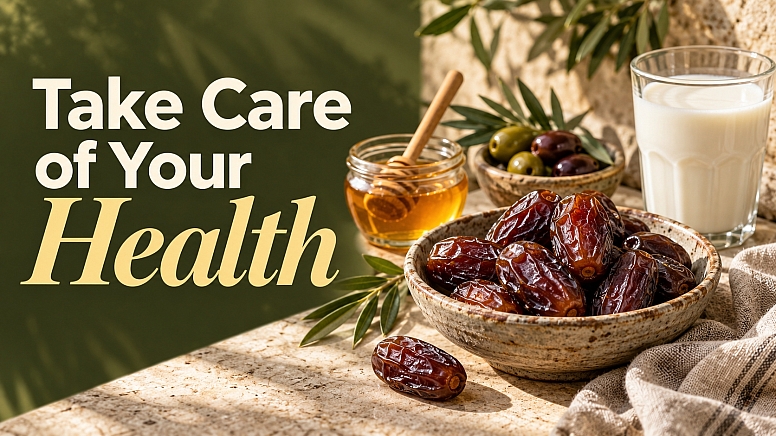
Take care of your health
Islam teaches us that our bodies are a trust from Allah. We are not meant to neglect them, nor are we meant to treat them as something that has no rights over us.
The Prophet ﷺ said to Abdullah ibn Amr رضي الله عنهما:
“Your body has a right over you.”
Sahih al Bukhari, 5199
This is a simple statement, but it carries an important reminder. Our health matters. The way we eat, drink, sleep and look after ourselves can all become part of our responsibility before Allah.
Your Body Has a Right Over You
It is easy to become so busy with work, family and other responsibilities that we forget to look after ourselves.
We may sleep too little, eat carelessly, avoid exercise and ignore signs that our body needs attention. Sometimes we only think about our health when something goes wrong.
But Islam teaches us to take care of ourselves before that point.
Looking after your health does not mean becoming obsessed with appearance or following every health trend. It means recognising that Allah has given you a body and that you should treat that blessing with care.
Eat and Drink With Moderation
Allah says:
“Eat and drink, but do not be excessive. Indeed, He does not like those who commit excess.”
Qur’an 7:31
This verse gives us a principle that can be applied to our everyday choices.
We do not need to follow every diet that becomes popular or completely change our lives overnight. We can simply become more conscious of what we put into our bodies.
Instead of always choosing what is convenient, we can make better choices where we are able. Instead of eating until we are uncomfortable, we can learn moderation.
Small decisions repeated every day can have a significant effect on our health.
Olive Oil and Honey
The Sunnah also gives us examples of beneficial foods.
The Prophet ﷺ said:
“Eat olive oil and use it, for it comes from a blessed tree.”
Jami al Tirmidhi, 1851
Olive oil can therefore be included in our diet as a wholesome food that was praised by the Prophet ﷺ. The hadith is not telling us that olive oil is a cure for every illness, but it reminds us that good foods can be part of a healthy way of living.
Honey is another food mentioned in the Sunnah.
A man came to the Prophet ﷺ and told him that his brother was suffering from an illness of the stomach. The Prophet ﷺ told him:
“Let him drink honey.”
He continued to advise this, and eventually the man recovered.
Sahih al Bukhari, 5684
The Prophet ﷺ also personally liked honey.
The Wisdom of Ibn al Qayyim
The scholars of Islam also wrote about health and nutrition.
Ibn al Qayyim رحمه الله, in Zad al Maad, discussed the Prophet's ﷺ approach to preserving health. Among the drinks he mentioned was honey mixed with cool water, describing it as part of the Prophetic approach to drinking and maintaining health.
This is worth remembering, but we should distinguish between the words of the Prophet ﷺ and the observations of later scholars.
Looking After Ourselves Is Not Selfish
Sometimes people think that spending time looking after their health is unnecessary or selfish.
But a healthy body can help us worship Allah, work, support our families and serve other people.
Getting enough sleep can help us wake for Fajr. Eating well can give us energy. Staying active can help us remain capable of doing the things Allah has given us responsibility for.
Even ordinary health choices can therefore have a greater purpose.
The question is not simply, “How can I become healthier?”
It can also be:
“How can I look after the body Allah has entrusted to me so that I can use it in what pleases Him?”
A Sunnah We Can Practise Every Day
Protecting our health does not have to begin with something complicated.
We can start by drinking enough water, choosing nourishing foods, eating with moderation, getting proper rest and keeping our bodies active.
We can enjoy foods such as olive oil and honey while remembering the guidance found in the Sunnah.
We can also seek medical treatment when we are unwell rather than neglecting our health.
These are ordinary things, but Islam teaches us that ordinary actions can have meaning when they are done with the right intention.
A Better Way to Look After Our Health
Our bodies are temporary, but they are still a trust.
We should not abuse them through constant excess, nor should we neglect them as though they have no rights over us.
The next time we eat a meal, prepare a drink, decide when to sleep or choose whether to be active, we can remember the words of the Prophet ﷺ:
“Your body has a right over you.”
Looking after our health is not about chasing perfection. It is about gratitude for the blessing Allah has given us and using that blessing well.
LEAVE A COMMENT
Categories
Recent Posts






0.0327