

What Truly Matters Before Allah
ʿAbdullah ibn ʿUmar رضي الله عنهما was known for his generosity and his eagerness to give for the sake of Allah ﷻ. One incident from his life shows just how seriously he took charity.
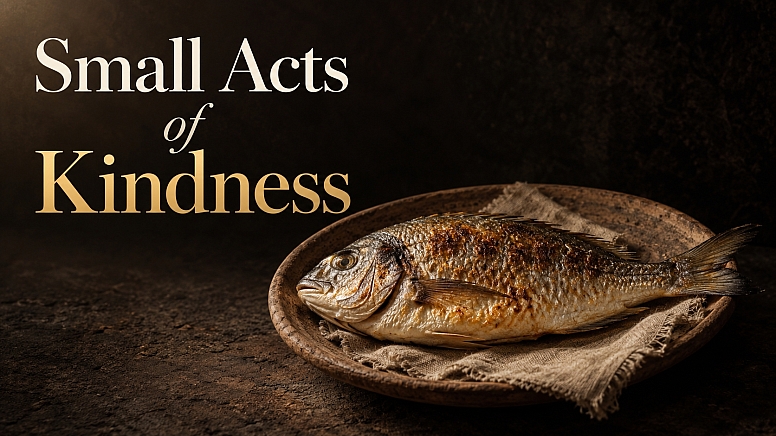
On one occasion, he became ill and developed a craving for fish. His family prepared some fish for him, and after waiting for it, he was finally about to eat.
Then a beggar came to the door.
ʿAbdullah ibn ʿUmar رضي الله عنهما told his family to give the fish to the beggar. His wife had prepared it especially for him, so she wanted him to have the meal he had been looking forward to. She even went to the beggar and offered to buy the fish back so that her husband could eat it.
But when the fish was brought back, ʿAbdullah ibn ʿUmar رضي الله عنهما gave it to the beggar again.
Why would someone give away something they had been craving?
Because he understood something that is easy for us to forget. The things we give up for Allah ﷻ are never truly lost.
Allah ﷻ says:
“You will never attain righteousness until you spend from what you love. And whatever you spend, indeed Allah is Knowing of it.”
Qur'an 3:92
This verse gives charity a different meaning. It is easy to give away something we do not particularly want. Perhaps we have clothes sitting unused in a cupboard, food we do not like, or something we were already planning to throw away.
But giving something that we actually love is different.
It requires sacrifice.
ʿAbdullah ibn ʿUmar رضي الله عنهما did not simply give away something that meant nothing to him. He gave away the very thing he had been looking forward to eating.
What Can We Learn?
Give from what you love.
The next time you give charity, ask yourself whether you are only giving what is convenient. Could you give something better? Could you choose the nicer item when donating clothes? Could you buy a good meal for someone who is struggling instead of giving them whatever you do not want?
Charity does not have to be expensive. What matters is the sincerity behind it.
Do not underestimate small acts of kindness.
A small gift given sincerely for Allah ﷻ can be far greater in value than a large gift given without thought.
Look after those who ask for help.
The beggar in this story arrived at the moment when ʿAbdullah ibn ʿUmar رضي الله عنهما was about to enjoy something he had wanted for himself. Yet he did not see the person at his door as an inconvenience.
He saw an opportunity to earn reward.
We can do the same. When someone genuinely needs help, instead of immediately thinking, “What will this cost me?” we can think, “What reward might Allah ﷻ give me for helping them?”
Teach generosity within the home.
There is also a beautiful lesson in the role of his wife. She had prepared the food with love and wanted her husband to enjoy it. This reminds us that generosity is not only the responsibility of one person in a family.
Families can encourage one another to give.
Parents can teach children to share. Husbands and wives can encourage each other to spend in charity. Brothers and sisters can remind each other that whatever is given sincerely for Allah ﷻ is never wasted.
The story of ʿAbdullah ibn ʿUmar رضي الله عنهما leaves us with a simple question:
What do I have that I love, and could I give some of it for the sake of Allah ﷻ?
It might be food, money, clothing, time or even something as simple as giving someone your attention when they need it.
Allah ﷻ does not need our possessions. We need Him.
And when we give something we love for His sake, we show that our love for Allah ﷻ is greater than our attachment to what we own.
Give generously. Give sincerely. And remember that nothing given for Allah ﷻ is ever truly lost.
LEAVE A COMMENT
Categories
Recent Posts









0.0259