
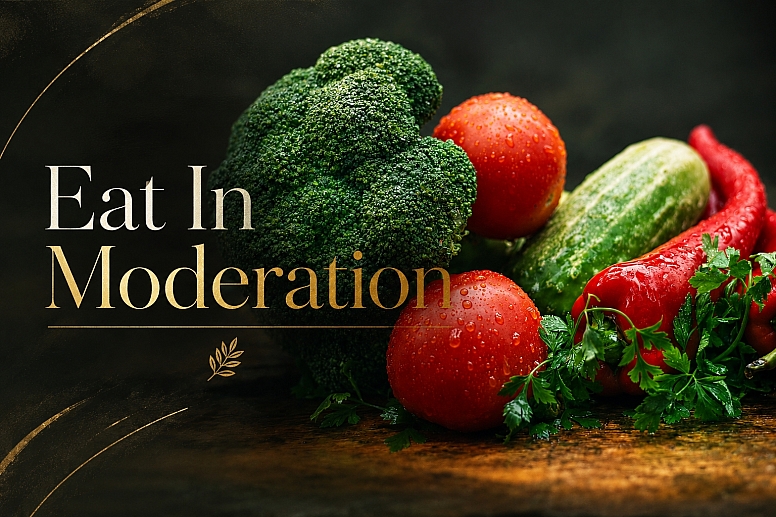
Eat In Moderation
The Messenger of Allah ﷺ said:
“The believer eats in one intestine, while the disbeliever eats in seven intestines.”
Sahih al Bukhari, 5393; Sahih Muslim, 2060
This hadith reminds us that eating is not simply about satisfying hunger. The way we eat can also teach us about self control, contentment and our relationship with the blessings Allah has given us.
Islam does not ask us to avoid good food or feel guilty for enjoying it. Rather, we are taught not to allow our desires to become excessive.
The Blessing of Food
Food is a blessing from Allah. It gives us strength, allows us to care for our bodies and gives us the energy to worship Him and fulfil our responsibilities.
Allah says:
“Eat and drink, but do not be excessive. Indeed, He does not like those who commit excess.”
Surah Al A'raf, 7:31
When we recognise food as a blessing, our attitude towards it changes. We become grateful for what is placed before us rather than constantly looking for more.
Being grateful does not mean refusing to enjoy food. It means enjoying it without becoming wasteful or excessive.
Knowing When Enough Is Enough
There is wisdom in learning to recognise when we have had enough.
Sometimes we continue eating because the food tastes good, because there is more available, or simply because we are used to finishing everything in front of us. But hunger and appetite are not always the same thing.
Learning to stop when we are satisfied is a simple way of practising moderation.
Before You Eat
Moderation can begin with small decisions.
We can take a reasonable portion rather than filling our plates with more than we need. We can eat slowly instead of rushing through a meal. We can pause before having another helping and ask ourselves whether we are still hungry.
These small habits can help us become more conscious of how much we eat.
This is not about becoming overly concerned with every meal. It is about developing enough awareness to recognise when we are eating out of hunger and when we are simply responding to desire.
A Sunnah We Can Practise Every Day
Eating in moderation is something we can practise at home, when eating with family, and when attending gatherings.
It is taking only what we expect to eat. It is avoiding waste when possible. It is being thankful for a simple meal instead of always wanting something more.
It is also learning that we do not have to satisfy every craving immediately.
There will naturally be occasions when we eat more than usual. A special meal, a family gathering or a celebration is not something that needs to be treated with suspicion. The important thing is that excess does not become our normal way of eating.
A Better Way to Eat
The Prophet ﷺ gave us a simple principle for how much we should eat:
“It is sufficient for the son of Adam to eat a few mouthfuls to keep his back straight. But if he must, then one third for his food, one third for his drink, and one third for his breath.”
Sunan al Tirmidhi, 2380
This gives us a practical reminder to leave room rather than filling ourselves completely.
Food should give us strength, not become something that controls us. When we eat with gratitude and restraint, we begin to appreciate what we have rather than constantly seeking more.
The next time we sit down for a meal, we can pause and ask:
Have I had enough?
Sometimes that simple question is all we need to remind ourselves to be grateful, exercise restraint and leave the table feeling satisfied rather than overly full.
May Allah make us grateful for the blessings He has provided, protect us from excess, and help us to follow the guidance of His Messenger ﷺ in the way we eat and live.
LEAVE A COMMENT
Categories
Recent Posts








0.0411